
Forgiveness: What Is It?
Transcript
Written by Tim Estes
You can:
- DOWNLOAD offline on your computer/tablet/phone as a PDF file and read it anytime, OR
- Use the CONTACT LINK above (under Services) to request your collection be sent to you via USPS. This will REQUIRE you to include your mailing address (U.S. only).
Forgiveness: What Is it?
HOOK
Intro
I am certain that you want the benefits of forgiveness. You want to be treated by others who use the Golden Rule. Jesus said Matthew 7:12 “So whatever you wish that others would do to you, do also to them, for this is the Law and the Prophets.” So, you want others to be good to you and forgive you for the accidental wrongs you have done to them.
You want reduced anxiety, less stress, and hostilities gone. You don’t want to be depressed. You want a healthy life with less risk of heart attack and lower blood pressure. I think you like to sleep at night.
And we want an ever-improving relationship with God. We are the ones who sin (Rom 3:23). We are the ones who make God turn his back on us, just like He did to Jesus when Jesus was on the cross. Jesus ask his father, “Why have you forsaken me?” (Matthew 27:46). It is our wrongs against him that cause a breakdown in our relationship to Him. (Isaiah 59:2). Those who do not follow God’s instructions will spend eternity in a place prepared for Satan, not people (Matt 25:41).
Since we need to start a practice of forgiving people, wouldn’t it be smart to figure out what forgiveness is and especially see it from God’s perspective? And it helps you and me to make sure we are both talking about the same thing. Together, we can eliminate any confusion.
The Greek word in the New Testament is aphiemi (ἀφίημι). Greek Scholars use words and phrases like “lay aside, leave, let alone, let go, put away, send away. Others say to “let be” or “disregard, and even “remit” or “keep no longer”. One scholar even said it was to “pardon”.
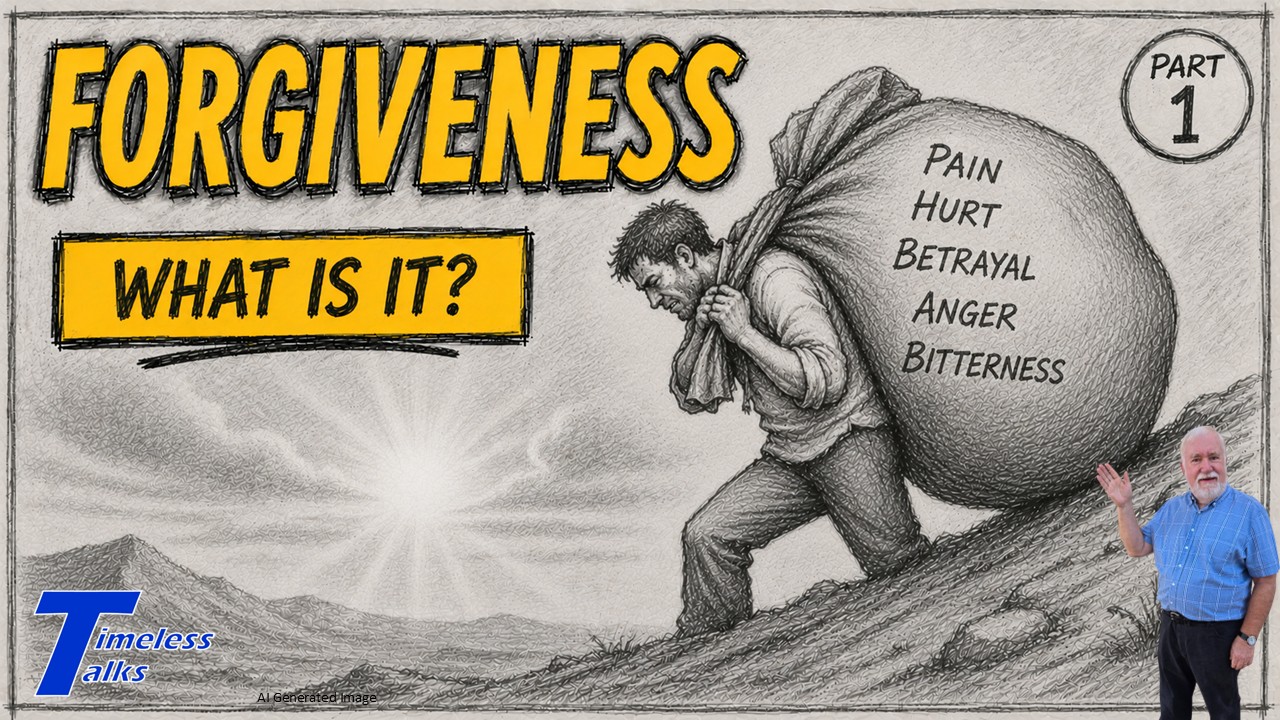
From these definitions, we can understand some key ideas, like laying aside the harm done to us. You no longer consider the wrong done to your person as something that can shape who you are or what you should do.
We understand we should make a conscious decision to walk away from the wrong. I will separate myself from its control over me.
I need to think of the wrongs done against me just like I think about poison ivy. Do you remember the expression about poison ivy? It was “Leaves of 3, let them be”. If you don’t “let them be”, they will torture you for a long, long time. Calamine lotion may help poison ivy, but doesn’t do much for forgiveness.
When we forgive, we “put it away” or “set it aside”. We no longer allow the problem to become an obstacle to our relationship with the offender.
When you extend forgiveness, you give up the “debt” created by the offense or emotional injury. You are considering the “debt”, injury, or insult as being paid in full. You will no longer exact or expect an apology from the wrongdoer. You see the debt as canceled or paid.
This is exactly what Jesus did when he died for us. Paul told the Colossians (2:13-14), “And you, who were dead in your trespasses and the uncircumcision of your flesh, God made alive together with him, having forgiven us all our trespasses, (14) by canceling the record of debt that stood against us with its legal demands. This he set aside, nailing it to the cross.”
Jesus, the master teacher, knew how to put these kinds of principles into stories, or parables, that we can see. If we could find one of these, we might get a clearer picture of both the one doing the wrong and the one being offended. Once we see that, we can begin to see what forgiveness is and why it is needed.
Jesus gave us the parable of the UNFORGIVING Servant. It is in Matthew 18:21-35. The context of the parable was that Peter had asked Jesus how often he should forgive someone, thinking that 7 times was plenty. Jesus told him, Matthew 18:22 “…I do not say to you seven times, but seventy-seven times.” And then the parable began. A king was settling accounts with his servants. He wanted the servants to pay their bill in full. One of his servants owed him 10,000 talents. That would be the equivalent of the mathematical problem you see here. 1 talent = 6,000 denarii/6,000 days of work. 10,000 talents = 60,000,000 days of work or 164,000+ years of work. It was not payable.
What is a king to do? Oh, yes. SELL the slave. Sell his wife. Sell his kids. He was going to cut his losses and be done. Then the servant begged the king, “Be patient and I will pay you everything.” The king pitied the servant. He forgave him the impossible debt. What should the servant have felt? Release? A fresh start? A new beginning?
But that same servant had a fellow servant who owed him the equivalent of 100 days’ wages. Days, not multiples of 1000s of years. The forgiven servant snatched up his fellow servant and began to choke him, just like someone mobster’s enforcer. The fellow servant begged for patience. What happened next? (Matthew 18:30) “He refused and went and put him in prison until he should pay the debt.”
Both of these debtors-servants had other fellow-servants. What the other servants witnessed caused them great distress. They went and told the master everything.
The master called the forgiven servant in for a face-to-face meeting. Here is what happened next. “Then his master summoned him and said to him, ‘You wicked servant! I forgave you all that debt because you pleaded with me. (33) And should not you have had mercy on your fellow servant, as I had mercy on you?’ (34) And in anger his master delivered him to the jailers, until he should pay all his debt.” (Matthew 18:32-34) The forgiven servant had his debt re-instated because of his own lack of forgiveness. The forgiven servant did not cultivate a forgiving and merciful attitude. And the man who had been forgiven spent the rest of his life separate from his friends, his wife, his children. He was going to die in prison.
Jesus finished his illustration to Peter by saying, “So also my heavenly Father will do to every one of you, if you do not forgive your brother from your heart.” (Matthew 18:35) What lesson did Peter learn? What lesson are we learning?
On the final days of Jesus’ ministry on earth, the Passion Week, he addressed this same subject again with all his disciples. He had already had the Triumphal Entry. He had shut down business in the place of worship when he cleared out the “den of robbers”, as he called them. He was finishing his discussion of mountain-moving faith. In this context, he told those disciples, Mark 11:25, “And whenever you stand praying, forgive, IF YOU HAVE ANYTHING AGAINST ANYONE, so that your Father also who is in heaven may forgive you your trespasses.”
What benefit do both these statements by Jesus show us? What is different between this teaching and the parable? Yes, everyone who has received the forgiveness of their sins needs to be developing a spirit of forgiveness and mercy. And while we are praying with faith that moves mountains, forgive.
Now, Jesus’ later statement emphasizes the EXTENT of the forgiveness. It also plainly says WHAT is to be forgiven, and WHO is to be forgiven. And it reminds us of the consequence if we don’t forgive.
Speaking of benefits, the next video in this 4-video series, part 2 (Forgiveness: Why Forgive)(Transcript), will be looking at the physical, mental, and spiritual benefits of forgiveness. There are so many great reasons to forgive. Please watch it very soon.
Do you need help in becoming more forgiving? Is it a hard struggle for you? We want to help. Give us a call and leave a voice message, or send us a text to____. Help will be on the way. We have free booklets that relate to this forgiveness idea. Take a look at our booklet page; select one. Read it, download it, or request a printed version. All free.
Do you need forgiveness of sins that are against God? We have multiple ways of helping. Use the phone number, or reach us through the contact page here at TimelessTalks.Net. Don’t wait. Do it now!
Thanks for watching. We want only the best for you. So, don’t wait till tomorrow to visit with us again. Watch the next video now. We will see you in just a moment.