
Giving Thanks In Hard Times
Transcript
Written by Barry Haynes
You can:
- DOWNLOAD offline on your computer/tablet/phone as a PDF file and read it anytime, OR
- Use the CONTACT LINK above (under Services) to request your collection be sent to you via USPS. This will REQUIRE you to include your mailing address (U.S. only).
Giving Thanks In Hard Times Transcript
Thanksgiving is probably the most American holiday. It starts with the Pilgrims and the Mayflower, and the very first Thanksgiving. But Thanksgiving was a holiday at times. George Washington issued a proclamation of Thanksgiving, but it never really became a national holiday until one of the more unusual times in history. Probably the time you would think that our country wouldn’t be thinking about Thanksgiving is when it actually started.
Thanksgiving didn’t become a national holiday till the Civil War. It was Abraham Lincoln who issued the first national proclamation for Thanksgiving. I’d like to read it to you.
“This year is drawn towards its close and has been filled with the blessings of fruitful fields and healthy skies, to these bounties which are so constantly enjoyed and which are prone to forget the source of which they come. Others have been added which are so extraordinary in nature that cannot fail to penetrate and soften even a heart which is habitually insensitive to an ever-watchful providence of an Almighty God. In the midst of a civil war, unequaled in magnitude and severity, which has sometimes seemed the foreign states to invite and provoke their aggression, peace has been preserved within the nation. Order has been maintained, the laws have been respected and obeyed, the harmony has prevailed everywhere of military conflict. While that theater has been greatly contracted by the advancing armies and navies of the Union, no human counsel hath devised nor hath any mortal worked out these great things. They are the gracious gifts of a Most High God, who while dealing with us in his anger for our sins, has nevertheless remembered mercy. It seemed to me, fit and proper, that they should be solemnly, reverently, and gratefully acknowledged with one heart and one voice by the whole American people. I do therefore invite my fellow citizens in every part of the United States and those who are at sea and those who are so journeying in foreign lands to set apart and observe the last Thursday of November next as a day of thanksgiving and praise to our beneficent Father who dwelleth in the heavens.”
Here we have Abraham Lincoln. In the midst of the Civil War, one of the greatest tragedies, greatest difficulties that our country had ever faced saying what we need to stop and do is give thanksgiving to our God.
There are often times in our lives where we feel like thanksgiving isn’t warranted, when times are difficult, when we’re struggling. And in those times, it might be that we really need to think the most about thanksgiving.
Thanksgiving is an attitude of gratitude. And sometimes we assume that that’s the expectation we should have, but is that really the case?
We read a story about Jesus in Luke chapter 17 and verses 11 through 19 when he was passing between Samaria and Galilee. And it said, “He entered a village, and ten leprous men stood at a distance with him. And they raised their voices, saying, “Jesus, master, have mercy on us.” And he saw them, and he said, “Go and show yourself to the priests.” And they were going, and they were cleansed. Now, one of them, when he saw that he had been healed, turned back, glorifying God, and at his feet, giving thanks to him. And he was a Samaritan. And Jesus answered and said, “Were there not ten cleansed, but where are the nine?”
Even Jesus experienced ingratitude. Maybe one out of ten is the number we should expect. About 90% of the people won’t ever say thank you. 90% of the people won’t ever show gratitude. But Jesus said, “This one man returned.” And because of that, he told him, “Stand up and go. Your faith has made you well.”
Gratitude isn’t something that always comes naturally to us. Even what did Lincoln say, the habitual attitude of ingratitude? That we sometimes forget all the things that we have because we’re so busy looking at the things that are wrong. We see all the little problems in our lives, and we forget that they could be so greatly compounded if not for our God.
And there’s a real danger when we’re not thankful. In Romans chapter 1, we see the beginning of the fall of mankind. And Paul writes Romans; he talks about how in verse 20, “Since the creation of the world, God’s invisible attributes, His eternal power, His divine nature have been clearly seen, understood through what has been made, so they are without excuse. For even though they knew God, they did not honor Him as God or give thanks.”
Notice there, what caused mankind to fall? He forgot about God, and He didn’t give thanks. Thanksgiving is when we look and realize what God has done for us.
Paul would say they professed to be wise, but they became fools, and they exchanged the glory of an incorruptible God for the images in the form of corruptible man. What is he saying? We replaced God with our own creations, but then we wondered why everything didn’t seem to go as well.
I think that’s what exactly happens to so many people. We forget about all the good things that God blesses us with. We just begin to expect them and think that they are the norm. And when they’re not there, we complain, we gripe, we’re upset about it, instead of stopping and thinking about all the things that we do have. Ingratitude is a very dangerous trait. It led mankind to fall away from the true and living God.
Paul would write in 2 Timothy 3: 2 about those in later times and those wicked men who would be lovers of self, boastful, arrogant, revilers, disobedient to parents. Notice this: “ungrateful, ungrateful and unholy and unloving and irreconcilable, malicious gossips without self-control, brutal and haters of good, treacherous, reckless, conceited, lovers of pleasure rather than lovers of God.”
As you read through that, you think, “Man, these are the worst people, right?” This is the degradation of society, but right there in the middle of it, ungrateful.
That’s because ingratitude makes us fall away from God. Ingratitude makes us not recognize how truly blessed we are to look up and realize that we wouldn’t have the things we have if it weren’t for a great and almighty God who delivers them to us.
We take so much for granted. I mean, we think about the weather, right? We go through a drought, and we complain about it not raining, or we have too much rain, and we’re worried about those things, but we don’t even realize we have no control over these things.
In fact, a lot of things we think we have control over, we’re pretty good in our day and age with medicine. We’re pretty good in our day and age with surgery. We can do so much to treat so many diseases, but ask any doctor, and they’ll tell you there’s only so much they can do. Sometimes there’s nothing in their power, whether someone will get well or not; then it’s God.
That’s why we’re told that it’s God’s will for us to be thankful. But sometimes that’s hard when we think there’s nothing to be thankful for.
Can I have you consider a passage of Scripture with me? If you turn over to Psalm 34, we read David writing a psalm of praise. He starts by saying, “I will bless the Lord at all times. His praise shall continually be in my mouth.” In verse 3, he says, “O magnify the Lord with me. Let me exalt his name together. I sought the Lord and he answered me. He delivered me from my fears and he looked to him and was radiant and their faces will never be ashamed.”
Here he talks about God in the greatest gratitude, in grateful terms. He talks about the God who saves him, the God who does all these things for us.
But I think it’s important to look at what he’s talking about in that passage. He encourages us there in verse 8 to say, “O taste and see that the Lord is good.” He says, “You need to try him out and he’ll prove you right.”
But we need to think about what David was going through. If you go back to the very start of that chapter, you’ll see an intro note where it talks about David, and it says, “This psalm was written when he feigned madness before Abimelech.”
This story is in 1 Samuel chapter 21:10-15. By the time David had to flee from Saul because Saul had turned against him, the people were praising David for all his accomplishments, all his achievements, and Saul being a petty man was very upset by that. He began to put David in more dangerous situations, even attacking him himself, until David finally realized that if he didn’t get out of there, Saul was going to kill him.
So, he fled to Achish, the king of Gath, because it was a familiar connection there. But when David gets there, Achish is nervous. He’s heard the songs about David, the ones that had made Saul so mad, the song that said Saul had slain his thousands but David his tens of thousands.
He begins to think that maybe David’s there as a spy. Maybe what he’s actually trying to do is gain some ground so he can overtake him. He’s very leery of David.
David realizes this and realizes he’s stuck between a rock and a hard place. He can’t go back to Saul and Achish is going to do something bad to him.
So, David comes up with a rather crazy solution, literally. It said when David heard these words to heart and greatly feared, so he disguised his sanity before them and he acted insanely in their hands. He scribbled on the doors of the gate. He let his saliva run down his beard. He basically acts like he’s a crazy person.
And Achish then says one of the more funny lines in the Bible. He says, “Behold, you see this man behaving as a madman? Why have you brought him to me? Do I lack madmen that you brought one to act the madman in my presence? Shall he come into my house?”
Achish basically says, “I’ve got enough crazy people around here. I don’t need this guy too.”
Well, David was just pulling a trick. He was feigning madness so Achish would accept him. He wouldn’t think he said, “Oh, that’s why Saul got rid of him.”
When you think about that situation, David is having to act crazy in order to survive. He’s walking around, scribbling on walls. He’s letting his saliva dribble down his face. You would not think of that as being good times, right? You’re having to act like a crazy person in order to survive. You’re on the run from one king; you’re fearful of another one. But that’s when David writes that psalm. This psalm of great praise to God, where he’s telling people, “Oh, taste and see that the LORD is good!” (Psalm 34:8, ESV), is written in this situation. I think it’s the same thing Lincoln was doing in the proclamation of thanksgiving.
Yes, these are bad times. Yes, there are struggles, but it’s in those times when we need to be most thankful.
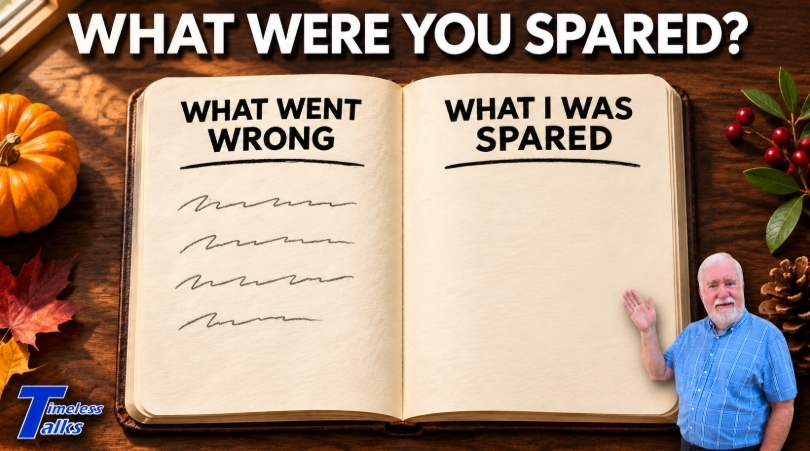
Those bad times are when we need to realize how good we have it. The blessings of God are so overwhelming that many times we just forget about them. Like the nine lepers, we just go about our business thinking, “Hey, I got what I wanted.” We never stop to go back and give thanks. We never stop to go back and be grateful for the one who did that for us. Even when we’re grateful, we’re not expressing it. And it’s in that expression that we draw closer to God. There’s a reason mankind falls when he’s not thankful. There’s a reason we become more wicked when we’re not grateful. Because it keeps us from stopping and realizing the power and the nature of God. This time of the year, we’ll spend time with our families. There’ll probably be a pretty good meal. We’ll watch some football. We’ll have some good times together. And those are truly blessings in themselves. But during this Thanksgiving season, make sure you think about not just the things that God has done for you, but all the things that he hasn’t allowed to happen to you. We should be grateful for just the things that haven’t happened to us in the past year. Take that time to stop and think about what God has done for you. In doing so, it will draw you closer to God. Because the more thankful we are, the more we see the power and the goodness and the glory of God.
Thank you so much for sharing this lesson. Please continue to follow us on TimelessTalks.Net. We would love to have you like us on Facebook. Follow us on the various platforms. We’d love to have any comments or anything that you’d like to have us talk about. We’d love to hear from you. Thank you, and have a wonderful day.