
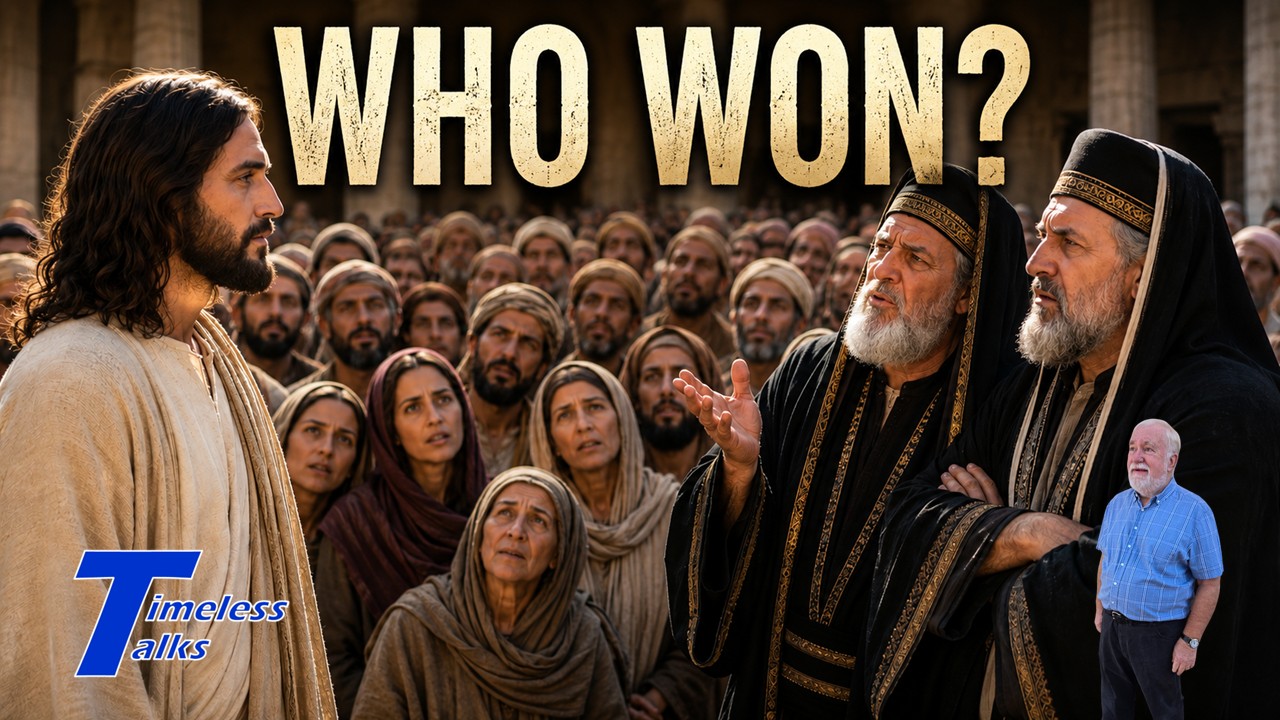
Who Won? Who Lost?
Transcript
Written by Tim Estes
You can:
- DOWNLOAD offline on your computer/tablet/phone as a PDF file and read it anytime, OR
- Use the CONTACT LINK above (under Services) to request your collection be sent to you via USPS. This will REQUIRE you to include your mailing address (U.S. only).
Who Won? Who Lost? Transcript
We all know people who, by their actions, are showing that what people think is everything to them. Think about any good politician. They watch the polls almost exclusively. If they do something honorable, they want everybody to know. And they don’t dare do anything that would be dishonorable because the public would turn against them.
Even in the days of Jesus, there was a cultural thing about honor and dishonor. It was the standard of Jesus’ day. There were people with honor, prestige, and strong public authority. They even wore special clothing to draw attention to how great they were
The religious leadership included all the local rulers of synagogues, the elders, both Chief Priests, scribes, and the 70-member Sanhedrin. They relished the notoriety of their position and public standing. In practical terms they were THE authorities when John the Baptist and Jesus came on the scene. They love it!
But Jesus ‘ miracles brought him increased attention and some public standing.
The “established authorities” did not like this “upstart”. They wanted to put him back in his place publicly.
This leads us to how public honor, or dishonor, was gained or lost. Over the years, a system called Challenge and riposte had developed in Judah.
Now what is a riposte? Consider it as a short, simple but powerful answer. For example, You have seen a reporter ask a powerful politician a very difficult question. Many times the politician will answer with something that sounds very Noble but actually means nothing. they said things in such a way that the public would think well of them even if their answer was meaningless. They have done a riposte.
There are basically four parts to this system of challenge-and-riposte.
Claim to honor → Challenge → Response/Riposte → Public verdict.
First, there is the claim to honor. That can be in the form of doing something good or noteworthy.
The second part is that of the challenge. This is when a question or situation is presented in which the opponent will have almost no choice but to concede the loss, or say something that will have a negative impact on their public standing.
The third part of this system was the response or riposte. The answer must be one in which one can defend themselves and yet not lose any public opinion, or maybe increase the public’s perception.
And the fourth part of this system was what the people thought. Public opinion mattered. Public opinion was the whole point.
It was through this system that Jesus increased in popularity and Authority while the religious establishment was being shamed. It was an honor or shame culture.
This is not like a present-day debate where there are rules and appropriate etiquette that must be maintained at all times. Most public debates today are over issues and are not personal attacks.
But during the days of Jesus, there were no written rules. But there were Unwritten ones to govern this public display. We will number a few just to make each one clear.
Rule #1: every challenge required a response. It could challenge a person’s authority, wisdom, status, and especially their honor. Ignoring a legitimate challenge could be interpreted as losing face.
Rule #2: the audience functioned as the judge. These exchanges were in public. The important issue was who appeared wiser or more authoritative in front of the crowd; honor was socially recognized.
Rule #3: The Challenger tried to put the opponent into a dilemma. A good challenge might force the respondent to choose between two damaging answers. Remember when Jesus was asked Is it lawful to pay taxes to Caesar or not? The challenges were designed so that either answer would be dangerous.
Unwritten rule #4. A successful response or riposte did more than answer the question. The strongest reply could reverse the challenge, exposing the Challenger instead. This is what Jesus repeatedly did to the religious establishment.
A final Unwritten rule: Counter questions were perfectly legitimate. Jesus often responded to a question with a question. The video you see here is the one in which we will be using and noticing this specific rule.
The pattern of these confrontations followed this pattern.
Claim to honor → Challenge → Response/Riposte → Public verdict
Let me show you a few examples from Jesus’ ministry that illustrate this point.
Open your Bible to Matt 22:23. In verse 23, the Sadducees were challenging Jesus with a question. Verses 24-29 are the challenge. It is a difficult situation without a positive answer. They want Jesus to fail.
You see in verse 29 it says Jesus answered them. He is accepting their challenge and will give them a response. The response is verses 29-32. Now let’s read verse 33. Matthew 22:33 And when the crowd heard it, they were astonished at his teaching.” What is the verdict of the public? They were astonished. That is like being super surprised that anyone could answer that question with such dignity and correctness siting the Old Testament scriptures. Jesus won.
Another example: Luke 13.10-17.
The setting is critical. It was the Sabbath. They were in a synagogue. A woman was there with a spirit that had made her unable to function for 18 years. She was bent over so much she could not straighten herself up. Jesus just spoke to her and freed her from her disability by laying his hands on her. She immediately was able to stand up straight. And she glorified God, verse 13 says. That was a claim to honor, part 1.
The ruler of the synagogue became indignant. He was losing his control over that synagogue. It was embarrassing to him that work was done on the Sabbath in his synagogue. So he challenged Jesus with what it says in verse 14. Luke 13:14 But the ruler of the synagogue, indignant because Jesus had healed on the Sabbath, said to the people, “There are six days in which work ought to be done. Come on those days and be healed, and not on the Sabbath day.”
The unwritten rule requires a positive, powerful response from Jesus. Verse 15 says the Lord answered him. What follows is his response or riposte. His response is a question. He asked if they had an ox or a donkey, would they not lead that donkey out from the feeding trough so it could have water? And then he followed with a second question. Shouldn’t this woman, someone who has been bound by Satan for 18 years, be released from her bond on a Sabbath?
What did the public think? The answer is in verse 17. Luke 13:17 As he said these things, all his adversaries were put to shame, and all the people rejoiced at all the glorious things that were done by him. The ruler of the synagogue was shamed. And the people, the public, were rejoicing over the result. Jesus had gained honor. He had won, again! They were so happy over the woman being relieved of her problem, and how Jesus had defended himself with dignity and honor.
This pattern happened often when Jesus was challenged.
How do his many victories affect your life now and in eternity?
But we can’t say that Jesus won every time. There was one day Jesus lost everything. But he lost it on purpose. It had been planned for centuries.
Think with me. What happens to people when they are constantly put down, publicly verbally battered, losing their public value, becoming totally trivial? Just like a dog that has been repeatedly beaten, when cornered, will attack with vengeance in its eyes. That is what the religious establishment did, beginning with Judas’ betrayal.
Jesus’ arrest was out of public sight, so as to not experience more public disgrace. They went to the home of the high priest (Mark 14.53), not into a public place. They tried using false witnesses to create a charge so they could have Jesus executed. You know that it failed.
But what was Jesus doing? Mark 14.61 – he remained silent and made no answer. NOW, the establishment is winning, and Jesus is losing.
The false witnesses could not agree, leaving Caiaphas in desperation. Finally, he asks Jesus, “Are you the Christ?” – that was the Challenge. Jesus’ riposte/answer was “I Am.” Mark 14.62
And Jesus, with that truthful but unusually less-than-powerful riposte, GAVE THEM the power to execute him for blasphemy. JESUS PURPOSEFULLY LOST
Next they go to Pilate, because the Roman government was the only one that could execute anyone. Again, another case of Challenge-Riposte as Jesus stood before Pilate.
Pilate made the Challenge. Mark 15.2. “Are you the KING of the Jews?” Pilate wanted to see if Jesus was a threat to his political position. Jesus told him, “You have said so.” Mark 15.2.
Because Jesus was losing public opinion rapidly, the Chief priest kept making many more challenges, but Jesus did not Riposte. He kept silent. Mark 15.5 says he made no further answer.
In Pilate’s eyes and the public’s opinion, Jesus was the LOSER. So Pilate ordered the execution of a LOSER.
In all this, you see that Jesus was always in control of every situation. He won when it was needed for the people of his day, and of us today. This is where much of his important teachings lie.
But he lost when it was most important.
The cross had been the goal of deity since the world was created and Adam and Eve sinned. It was planned by God the Father and assisted by Jesus himself by LOSING. Jesus became the atoning sacrifice.
Jesus had said, John 10:17-18 For this reason the Father loves me, because I lay down my life that I may take it up again. (18) No one takes it from me, but I lay it down of my own accord. I have authority to lay it down, and I have authority to take it up again. This charge I have received from my Father.”
Jesus LOST, so that you can be a WINNER.
Would you like to know more about this Jesus, the one who lost for your sake? We can help. Being by texting this number that you see here, or call and leave a voice message. After a brief visit, we will offer suggested ways, designed for your specific need. Or you can reach out, like many are doing, through our contact page at TimelessTalks.Net. There, we have plenty of videos, transcripts, e-booklets, all for you. We even have an online Bible correspondence course that you can complete at your own pace. Let’s visit today.
And a quick reminder for you to follow this video with the one you see here. Jesus has his Authority Challenged.
See you tomorrow. Goodbye for now.