
Can Truth Be Weaponized?
Transcript
Written by Tim Estes
You can:
- DOWNLOAD offline on your computer/tablet/phone as a PDF file and read it anytime, OR
- Use the CONTACT LINK above (under Services) to request your collection be sent to you via USPS. This will REQUIRE you to include your mailing address (U.S. only).
Can Truth Be Weaponized?
These are hard questions. Can truth be weaponized? Was truth weaponized against Jesus? And can truth be weaponized against you?
INTRO
We are answering these 3 questions because everyone in America today must be aware of “weaponization”. We hear about it in politics, in law, even in national security concerns. Consider how crude oil is being “weaponized” by many Middle Eastern entities against the United States. At the time of this recording, in SW Arkansas, gas prices have leaped to between $3.89 to $4.69 per gallon.
What is weaponization? It is to adapt an ordinary object, substance, or concept for use as a weapon to deliberately inflict harm or gain a strategic advantage.
Let’s answer the first question: “Can truth be weaponized?”. Here is an example that should answer the question.
First example: The truth: Republican Rep. Mike Collins really did say: “get off of Social Security, get back into the workforce” as part of a longer speech. What happened is an example of weaponization. Democratic Sen. Jon Ossoff’s campaign put those actual words into an advertisement suggesting Collins wanted to push seniors off Social Security. The ad even replayed the clip.
So, to answer our question, “Can truth be weaponized?” Yes. Especially if truth is taken out of context.
Our second question is “Was Truth Weaponized against Jesus”? Every part of me wants to completely reject the very idea that someone, anyone, would even consider using truth against my Lord and Master. But to simply reject the question does not answer the question. So, let’s see what happened during the Passion Week.
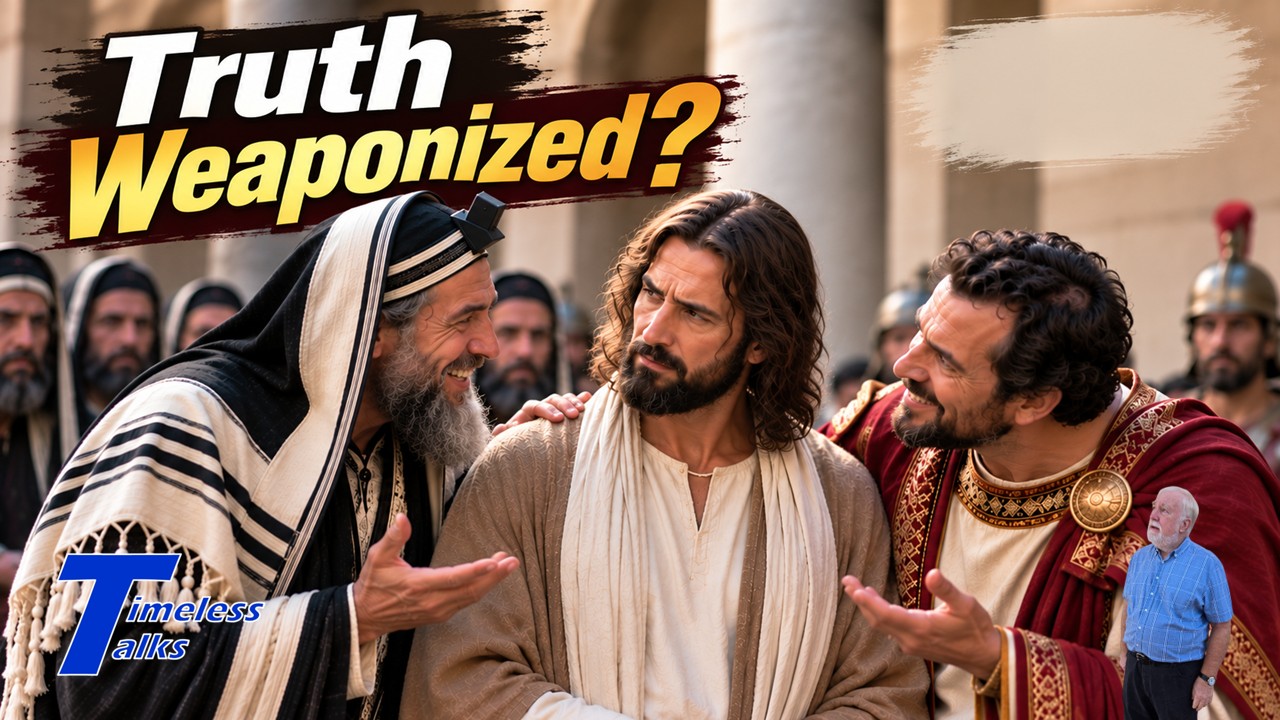
Mark 12:13-14 says, “And they sent to him some of the Pharisees and some of the Herodians, to trap him in his talk. 14 And they came and said to him, “Teacher, we know that you are true and do not care about anyone’s opinion. For you are not swayed by appearances, but truly teach the way of God. Is it lawful to pay taxes to Caesar, or not? Should we pay them, or should we not?”
Jesus knew these men were a bunch of hypocrites (Mark 12:15)
Before we delve deeper, we need to make a quick note about both these groups. The Pharisees, wearing brown, were strongly committed to religious purity of the Jews. They were a driving force, expecting the Messiah to rid the Jews of the Romans. But the Herodians, wearing Roman red, were very different. They were not concerned about religious purity. They were trying to improve their relationship with the Roman officials, and supported their interests. They were enemies of each other, but BOTH of them wanted their honor and prestige back from Jesus. So they joined together to trap him. They wanted to embarrass Jesus publicly, to shame him, and gain honor for themselves.
Amazingly, these hypocrites make four powerfully true statements about Jesus. Each one deserves a quick examination.
They said to Jesus, “You are true.” Now, it did not say that Jesus was truthFUL, but that he is “true”. They used a word that means “real, genuine, unconcealed, and true to fact”. We might say it like, “What you see is what you get.”
Jesus did teach about integrity, compassion, forgiveness, truth, and to treat others like you want to be treated. But their statement is also based on how he lived. He lived a life of integrity. He had compassion over and over. He forgave the sins of the paralytic and did not condemn the woman caught in adultery. Everything he taught, he lived.
You know what Jesus taught. He taught me and you. He expects you and me to be like him. He wants every person on earth to be a disciple first. So he expects us to live so well that people could say about us, “You are true”.
Their second statement was, “You do not care about anyone’s opinion”. They were saying he was not influenced or intimidated by status or opinion. We might say it like, “You won’t change your answer because of what somebody is thinking.”
And they were right. Martha asked, “Lord, do you not care that my sister has left me to serve alone? Tell her then to help me.” Luke 10.40. Jesus told her that her sister had chosen something better: to stop, sit, listen, and learn from Jesus instead of trying to set the dinner table. He did not change.
Since Jesus is not going to change what he has said, why should we try to bargain anything with him? I have heard people say that Jesus is so loving that he can’t send anyone to hell. But they’re not listening to a man who said there are 2 paths: one broad that leads to destruction, and many are going that way. And there is a narrow, constrained way that leads to life, and there are few on that path. Remember how Jesus said in “Heaven and earth will pass away, but my words will not pass away.” Jesus is not going to consult with you about what he should or should not say. What he said will not change.
The third true statement they said was “You are not swayed by appearances.” This is similar to what we have just said. But the previous was based on what people thought, like a political poll. But this third statement is based on the status of the person speaking. What they meant was that Jesus would not be swayed. They might have said like this: “You don’t treat people differently because of who they are.”
When you look over Jesus’ life, he told Nicodemus the same thing he would tell you. When Pilate asked him if he was the King of the Jews, Jesus said, “I am”.
Jesus expects us to imitate him. If you talk badly to a superior about a coworker to promote yourself, is that right? Even if what you are saying about the coworker is true, does your weaponizing truth make it ok?
The fourth statement they said was, “you truly teach the way of God.” This one may be the most important of all. Jesus in the Sermon on the Mount, found in Matthew 5-7, was explaining what God wanted for his people. Jesus did say to the eleven, “but I do as the Father has commanded me, so that the world may know that I love the Father. …”. These hypocrites could just as easily have said, “What you teach comes from God, and you teach it truthfully.”
We need to be like him. When we are explaining any Bible subject or text, we make sure we keep everything in context, and tell people what they should know. “whoever speaks, as one who speaks oracles of God; …”
Were these mutual enemies trying to create in Jesus an over-confidence so he would make a public mistake? I doubt it. Jesus knew how hypocritical these men were.
So, unfortunately, these men were attempting to use truths against Jesus. It is an unpleasant idea, but we have seen that it is true.
Now, the last question. “Can truth be weaponized against you?”
These 2 groups weaponized truth against Jesus. If it happened to Jesus, can it happen to you? Is it possible that someone may dislike you? Could someone want to gain an advantage over you? Do people want to embarrass you? Could someone desire to elevate themselves even at your expense?
Before you answer those questions, add this thought to the mix. If you are someone who is diligently working daily to be just like Jesus, and they attacked him, will they come after you? They very well could use truths about you, the same truths that were used against Jesus, to dishonor you.
Jesus told both of us, “A disciple is not above his teacher, nor a servant above his master. 25 It is enough for the disciple to be like his teacher, and the servant like his master. If they have called the master of the house Beelzebul, (what they had called Jesus) how much more will they malign those of his household.
He also said, “Remember the word that I said to you: ‘A servant is not greater than his master.’ If they persecuted me, they will also persecute you. …”
So the answers to our questions are:
Question 1: YES
Question 2: YES
Question 3: YES
So what can you do to help yourself? Remember that in Joshua chapter 1, Joshua was told 3 times to be “strong and courageous.” In verse 9, God recorded, “Have I not commanded you? Be strong and courageous. Do not be frightened, and do not be dismayed, for the LORD your God is with you wherever you go.” Start by putting your complete trust in Jesus. He told us (Matthew 28:20) …And behold, I am with you always, to the end of the age.”
If you need help overcoming adversity, being talked about, or mistreated, please contact us at Timeless Talks. At Timeless Talks, we will just point you toward Jesus and God, giving you Bible answers to any of life’s difficulties. What you may need to do is call and leave a voice message, or send a text. You could also use the contact page at TimelessTalks.net to make a longer statement. We will get you the help you need as quickly as possible.
Thanks for watching. God bless you until we see you tomorrow. Until then, Goodbye for now.