
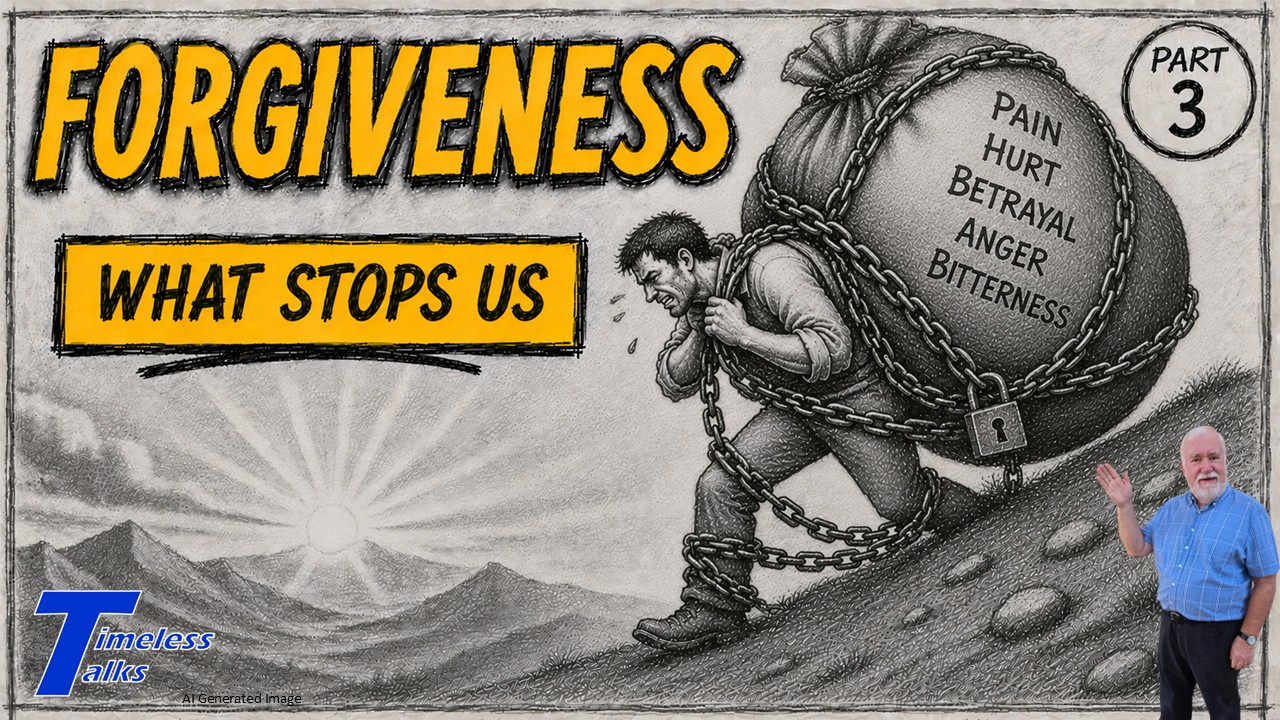
Forgiveness: What Stops Us
Transcript
Written by Tim Estes
You can:
- DOWNLOAD offline on your computer/tablet/phone as a PDF file and read it anytime, OR
- Use the CONTACT LINK above (under Services) to request your collection be sent to you via USPS. This will REQUIRE you to include your mailing address (U.S. only).
Forgiveness: What Stops Us
4-5 statements
Intro
We are excited that you have chosen to watch this video. We are examining 4 distinct angles about Forgiveness. And this one is going to look at motives relating to being someone who does not forgive.
But before we delve into this video of the heart, it is essential for you to go back to this video (Forgiveness: What Is It)(Transcript). Here you can begin to understand what forgiveness is, who needs to be doing the forgiving and who needs forgiveness. Then watch this video (Forgiveness: Why Forgive)(Transcript) so you get a clear picture as to what the benefits are. Some benefits are immediate, and other benefits point toward the far distant future when we are no longer living.
There is so much to gain by purposefully making decisions to let go of the insults from a co-worker. Someone, if not both partners, needs to decide not to hold their mate responsible for the hurtful things they said during a major argument. Forgiveness is needed to deal with the lies told about you by someone you respected and admired. Do you remember how mom or dad neglected or abused you? You need to forgive, but you just can’t. Or what about the time 20 years ago when a big lie was told about you? You lost your job. And then, unexpectedly, you saw that person in the grocery store today. Your blood pressure still jumps up 20 points every time you see, or even hear, them. The injury was so big and was very long-lasting. You are not letting go.
With any or all of these scenarios, what is needed is for the injured to make that heart-wrenching decision to “let it go”. No longer will you be dominated by that particularly painful event.
But why do people not forgive?
We went online and searched credible sources. Here are the top answers given as to why forgiveness is being withheld. These are in no particular order.
The American Psychological Association (APA) told us, “The offense was too serious.” People can believe that some wrongs are beyond forgiveness because it hurts so much. Another reason was “They don’t deserve forgiveness.” These folks see forgiveness as a reward that must be earned rather than a choice to be made for one’s own well-being. The APA also reported the anger-based response, “I want justice or revenge.” They desire the offender to suffer consequences and pain as they did. Both the APA and the Mayo Clinic reported the reason “They never apologized.” They are sharing a common belief that forgiveness should wait until the offender expresses some amount of remorse. And Mayo and APA reported, “I don’t trust them anymore.” They are confusing forgiveness with reconciliation.
These are only a few of the reasons.
Additionally, the Mayo Clinic reported some do not forgive because, “Forgiving means saying what they did was okay.” The Mayo Clinic and other health organizations repeatedly clarify that forgiveness does not mean excusing or condoning wrongdoing. Harvard Health Publishing reported how some say, “Holding on to anger protects me.” These individuals are convinced that keeping anger alive helps them avoid vulnerability and future mistreatments. And John Hopkins Medicine shares how people refused to forgive because, in their words, “If I forgive them, I might get hurt again.” Sadly, some have a fear of future injury. It causes them to hold on to resentment as if it were a form of self-protection. And the last reason we give comes from John Hopkins. People say they will not forgive because “Forgiving would let them off the hook.” Somehow, they think that if they forgive the offense, the responsibility and the consequences are removed.
Did you notice that in all these reasons and rationales, there were numerous false assumptions?
For example, the false assumption that forgiveness is equal to excusing wrongdoing. It is false because Sin is always sin. Forgiveness by a person does not remove sin. God is the only one who can forgive any sin. If marital infidelity creates a child, the raising of that child will also be affected. God allows consequences for sin. So nothing is excused.
And there is the false assumption that forgiving requires forgetting. We have all heard the expression “forgive and forget”. But that is not how life, or God, works. We do not have the power to force forgetfulness. If it was painful, we are likely to never forget. And God knows everything. If he forgot a sin, he would no longer be God or divine. When God forgives any sin, he no longer holds the punishment for that sin against anyone. In practice, when God forgives us, it is as though we had never done the wrong. That is justification.
A third false assumption is that forgiveness is equal to reconciliation. If BOTH parties forgive, reconciliation is possible, but not certain. Friendship is allowed, even encouraged. Think about it. God reconciled the world to himself through Jesus. Paul wrote, “…that is, in Christ God was reconciling the world to himself, not counting their trespasses against them, and entrusting to us the message of reconciliation.” (2 Corinthians 5:19). God did the forgiving of man’s wrongdoing or sin, and Paul and others carried a message of how to re-establish a relationship with God.
All of these reasons people give and the false assumptions were collected by health organizations, but what does God say?
God shows us that pride is a reason for not forgiving. If I were preparing a video specifically on pride preventing forgiveness, I would relate 3 parables and one event to you. I would show you how Jonah, after spending a few days in the large fish, then begrudgingly went to Nineveh with God’s message of what to do to avoid God’s destruction, and how those people did what God said, and he forgave them. This caused Jonah to resent God’s forgiveness of these Gentile people.
I would also point you toward the Unforgiving Servant. Go back to the first video and remember what happened to him because of his pride.
And what about that older brother in the parable of the Prodigal Son? He was so proud of how good a person he had been, while his brother was off wasting the family fortune in wild living. When his younger brother repented, he was so proud of his own life that he refused to be involved with his black sheep brother.
Jesus also told the parable of a Pharisee and a tax collector. Both were at the temple, but only the worship of 1 was accepted. The Pharisee prayed, telling God how good he was, and that he was so much better than that tax collector. But the tax collector stayed at a distance in the temple. He beat his chest. He kept asking God to be merciful to him. He admitted he was a sinner. Jesus said, “I tell you, this man went down to his house justified (that means he was forgiven), rather than the other. For everyone who exalts himself will be humbled, but the one who humbles himself will be exalted.” (Luke 18:14).
God tells us that bitterness can get in the way of being forgiving. We could, again, point to that older brother. His anger had been brewing for a long time. When his younger brother returned, and his father so gladly created a celebration, oh, the anger and bitterness that had been steaming for so long erupted. Jesus said, “But he was angry and refused to go in…” (Luke 15:28). Bitterness poisons relationships and blocks forgiveness. And bitterness was recognized by the writer of the book of Hebrews. “See to it that no one fails to obtain the grace of God; that no “root of bitterness” springs up and causes trouble, and by it many become defiled;” (Hebrews 12:15). The verse exposes the progression. Unresolved bitterness spreads trouble. And additional trouble makes forgiveness even more difficult.
What does God say about revenge? We find it in Paul’s writing to the Romans. “If possible, so far as it depends on you, live peaceably with all. (19) Beloved, never avenge yourselves, but leave it to the wrath of God, for it is written, “Vengeance is mine, I will repay, says the Lord.” (Romans 12:18-19). Revenge is something that should never be part of the Christian’s vocabulary, much less his lifestyle. God is the one who will take care of his people. So, just let the offense go. Don’t let them hang around and start destroying your life.
At this point, we know what forgiveness is, who should forgive, who needs forgiveness, the benefits of forgiveness, and why some people, maybe you, struggle to forgive. But we have not talked about HOW to forgive. God has some straightforward answers. You need them. So, watch this video. It is about How you can get started and how to be successful at forgiveness.
You have now completed 3 of the 4 videos in this series. Are you needing help with forgiveness? Or maybe some other issue? We are ready to hear your problem. Contact us. Use the phone number you see here. Call us. Leave a voice message, or better, send us a text message describing your situation. You could also use the contact page on TimelessTalks.Net to inform us of your situation and needs. And we have lots of free booklets about forgiveness and other problems on our booklet page. Get over there. Read the booklet online. Or download it. Or request a copy be printed and mailed to you. All for free.
But right now, you need to begin figuring out HOW to forgive. So, start watching this video right now (Transcript). Don’t wait. Don’t delay. Don’t wait till tomorrow. Watch this video right now. I’ll see you over there.