
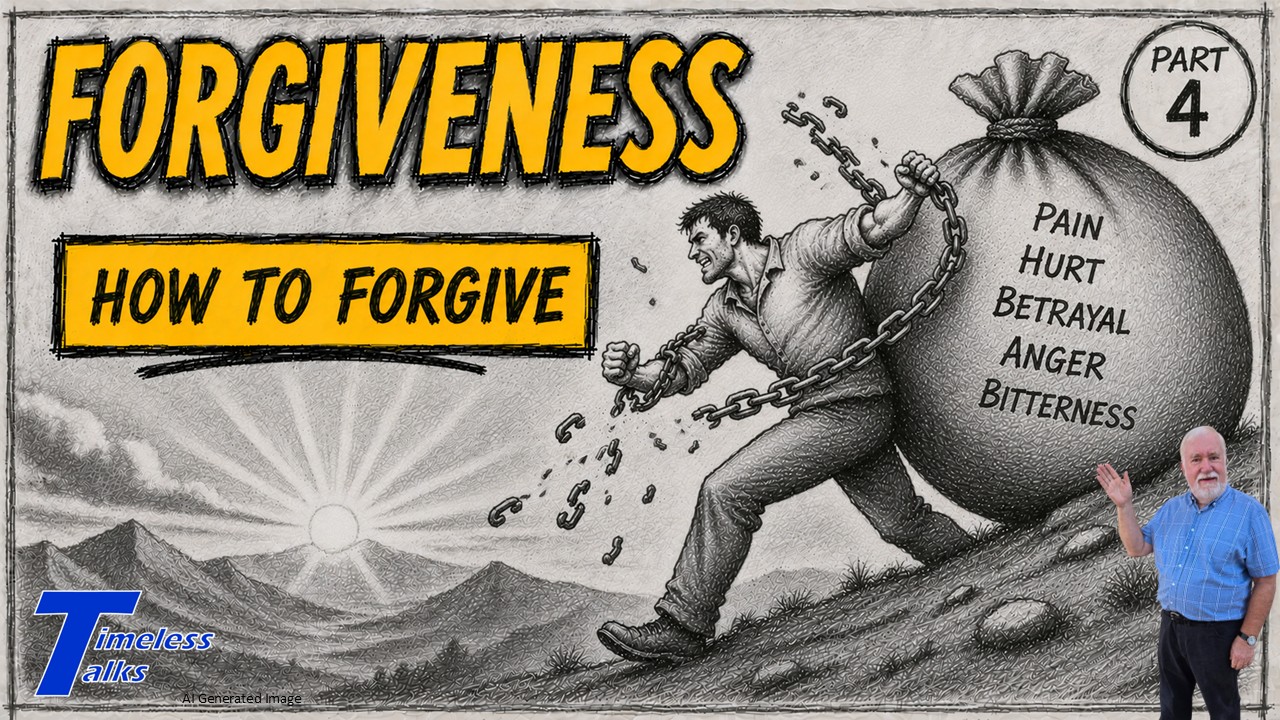
Forgiveness: How To Forgive
Transcript
Written by Tim Estes
You can:
- DOWNLOAD offline on your computer/tablet/phone as a PDF file and read it anytime, OR
- Use the CONTACT LINK above (under Services) to request your collection be sent to you via USPS. This will REQUIRE you to include your mailing address (U.S. only).
Forgiveness: How to Forgive
4-5 statements
INTRO
Ok, I get it. You and I are alike. When I want to know HOW TO do something, I skip straight to the how-to part. So, you saw the How To Forgive part and you came straight here. Well, that leaves you with a problem. This is actually the wrong place to start. Starting here will be more difficult to understand. To become forgiving is not like changing a lamp’s lightbulb. It is more complicated. You need to know who needs to be forgiving and who should receive forgiveness. This and the unforgiving servant are in Forgiveness: What Is It? (Transcript), the 1st video in this 4-video set. The 2nd video, Forgiveness: Why Forgive? (Transcript) reveals the kinds of benefits that the forgiver can have. Then Forgiveness: What Stops Us (Transcript) is a near prerequisite to this one. It tells, describes, and reveals answers to why people struggle with forgiveness. So, go back, start from the beginning, and make this much easier on yourself.
Do you remember those key words from Forgiveness: What Is It?? Remember the definition had “lay aside”, “leave”, “let go”, “remit”, “put or send away”, and my favorite “let alone”, just like you leave poison ivy alone.
Many of these words carry an element of separation in them. For example, in the New Testament era, if a Jewish man divorced his wife, he set her away. He put physical distance between himself and her. He did not keep her close.
Some of those keywords have the element of separation by time. An agreement or contract may expire and would no longer be enforceable. We can also think of criminal acts, that if not prosecuted within, say, 7 years, the district attorney cannot bring charges against the criminal.
You may have noticed that some key words carry the idea of “giving up on a debt” or to consider the debt as paid. This is the case with God. We have violated his words and laws. We are guilty. We are the offender. We need his forgiveness, but that comes only with the sacrifice of life itself. Paul told the Romans, “For the wages of sin is death…” (Romans 3:23). To appease God, we must die – die a death of suffering. God’s justice must be gained, but if you die in the process, well, heaven and eternal life become hopeless. But Jesus, God’s own son, took your place. He died for you. Now, God can be just. Now, when we choose to follow his commands, he forgives. He considers your debt as “paid in full,” by the blood of Jesus. “And you, who were dead in your trespasses and the uncircumcision of your flesh, God made alive together with him, having forgiven us all our trespasses, by canceling the record of debt that stood against us with its legal demands. This he set aside, nailing it to the cross.” (Colossians 2:13-14). Mankind has a way to be forgiven. It is because God considers our sin debt as paid.
In these keywords is the idea that the owner of the offense, that is, the one who is hurt or injured, just gave it up. They no longer hold on to it.
And remember that idea of “letting go” or “leaving it alone”? The one offended is not holding on to it, waiting for the offender to come with an apology. The offended is not picking the scab off the so-called “emotional wound”. The offender is not re-living the injury every day, just so he can protect himself with anger, or to keep the pain alive and well. The offended knows the issue is still there, but he is leaving it alone.
These various elements, both those just mentioned and those discussed in the first video, lead us to HOW we can forgive.
You could make a conscious, deliberate decision and send the offence itself away from yourself. Remember our Jewish man getting a divorce. Send it away. Or think of wrapping up the offence in a sheet, throw it off the bridge and into the water of life, and let the waters go “under the bridge.” Thus, you “send it away.” Why hang onto the problem? The offender may not even know they have hurt you, so they will never apologize. Divorce yourself from the injury. Put distance between you and it.
You could consider the wrongdoing as so long ago that it is no longer important to you or the offender. It is like the agreement that has expired, or the criminal case that cannot be prosecuted.
The very root word, in the Greek, points to another ‘How To’. Jesus used the word for “forgive” in Matthew 15:14. There, Jesus was speaking about the religious leaders of his time. He said, “Let them alone…”. Jesus was telling his listeners back then, and us right now, to decide consciously to have nothing to do with those leaders. When we decide to forgive, we are saying we will, from now on, have NOTHING to do with that wrong.
The calling of Peter, Andrew, James and John illustrates another ‘How To Forgive’. The four men were all professional fishermen. James and John, along with their father, were particularly successful. But when Jesus called them (Mark 1:18 & Luke 5:11), the Bible says they “left” their boats, the nets, everything. They completely separated themselves with the strong motivation to be disciples of Jesus. When you forgive, you leave it behind. You completely separate yourself from those hurt feelings. Walk away!
And lastly, what happened in the Garden of Gethsemane is a “How To”. Both Matthew and Mark tell us how the disciples “fled” from the arresting crowd with their weapons. That “fled” is the same Greek word. When we forgive, we are considering the wrong as something we need to “flee” from. It is toxic. It will be the cause of our being condemned to hell if we don’t forgive. It will kill our bodies, as we saw in Forgiveness: What Stops Us. So RUN! from the wrong. It is not a matter of how serious the hurt was. It is still deadly. It is not about justice or revenge. Those will kill you, too. If you think not forgiving is a way to keep from getting hurt again, consider this. If you hold on to a rattlesnake and don’t put him down and RUN, he will hurt you again and again. Put the wrong down and RUN FROM IT. You can watch it in your rearview mirror some other time.
Mark 11:25 told us, “And whenever you stand praying, forgive, if you have anything against anyone, so that your Father also who is in heaven may forgive you your trespasses.” Let’s start using the How To’s to forgive EVERYONE of EVERYTHING that has been done to hurt us, either accidental or intentional.
This will give you the greatest 2 benefits of all.
First, by you doing the forgiving, it allows our just God to forgive us. That is an idea we both agree is good.
And secondly, it gets us out of trouble with God. Remember the story of the unforgiving servant in Video 1? Remember how Jesus said, “And in anger his master delivered him to the jailers, until he should pay all his debt. So also my heavenly Father will do to every one of you, if you do not forgive your brother from your heart.” When we obediently live and forgive, we will be on our way to avoiding eternal punishment.
We are so grateful to you for watching this series of 4 videos on Forgiveness. But if these videos have revealed a flaw in yourself that needs help, we are here. We want only what is best for you, so call the number you see here. Leave us a voice message, or better yet, send us a detailed text to the number. You could also use the contact page at TimelessTalks.Net to let us know of your situation. Another resource on the subject of forgiveness is the many free transcripts and booklets we have online. Read them online, or download them to your phone, or even request a printed copy be mailed to you.
We are always here for you. So, let’s visit again, like tomorrow. Until then, Goodbye for now.